MTConnect 2.8 class
Representation
specifies the format and structure of result.
Description
The Representation type for an Observation is defined by the associated representation in the MTConnectDevices Response Document.
Value is the default Representation type for all Observation types.
The name of the Observation type is modified for all Representation types other than Value by appending the pascal case of the Representation type.
Example: The name for Sample Observation type Temperaturewith Representation type of TimeSeries becomes TemperatureTimeSeries.
Introduced in MTConnect 1.2.
Abstract class.
Subclasses
- DataSet
Representation for an
Observationcomposed of value(s) represented as a set of key-value pairs.Description
DataSetfor anObservationis defined by the associatedrepresentationasDATA_SET.representationasDATA_SETMUST havecategoryasSAMPLEorEVENT.VariableDataSet shows the model for
Variable(Eventtype) with a Representation type ofDataSet.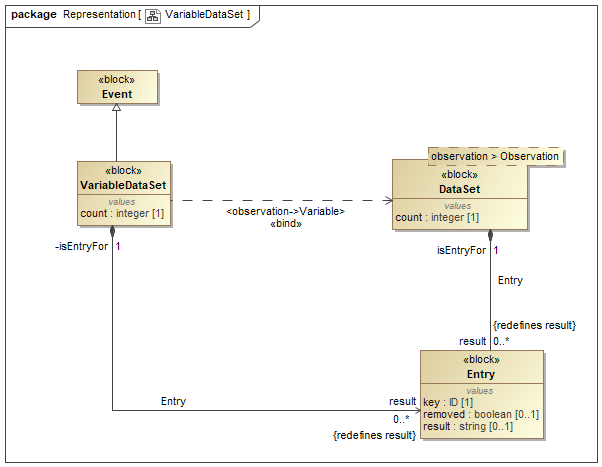
Note: See DataSet Schema for XML schema.
DataSetreports multiple values as a set of key-value pair where each key MUST be unique. The representation of the key-value pair is anEntry. The value of eachEntryMUST have the same constraints and format as theObservationdefined forrepresentationasVALUEfor theDataItemtype. (See Value).The meaning of each
EntryMAY be provided as theDataItemEntryDefinition.DataSet Example shows
EventObservationtypeVariablewith a Representation type ofDataSet.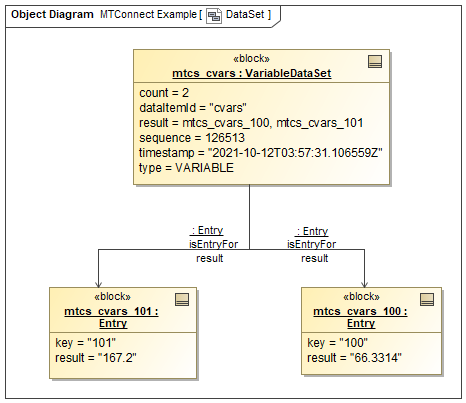
Note: See dataset-example for the XML representation of the same example.
Management of Data Set Observations
An agent MUST maintain the current state of the
DataSetas described in Fundamentals.One or more key-value pairs MAY be added, removed, or changed in an
Observation. An agent MUST publish the changes to one or more key-value pairs as a singleObservation. An agent MUST indicate the removal of a key-value pair from aDataSetusing theremovedastrue.When the
discreteisfalseor is not present, an agent in response to a sample request MUST only publish the changed key-value pair since the previous state of theDataSet.When the
discreteattribute istrue, an agent, in response to a sample request, MUST report all key-value pairs ignoring the state of theDataSet.When an agent responds to a current request, the response document MUST include the full set of key-value pairs. If the current request includes an
atquery parameter, the agent MUST provide the set of key-value pairs at the sequence number.When an
Observationreset occurs, theDataSetMUST remove all key-value pairs making the set empty. TheObservationMAY simultaneously populate theDataSetwith new key-value pairs. The previous entries MUST NOT be included and MUST NOT haveremovedastrue.When the
ObservationisUNAVAILABLEtheDataSetMUST remove all key-value pairs making the set empty.- Discrete
DEPRECATED Representation for an
Observationwhere each discrete occurrence of the data may have the same value as the previous occurrence of the data.Description
Discrete for an
Observationis defined by the associatedrepresentationasDISCRETE.representationasDISCRETEMUST havecategoryasEVENT.MTConnect Version 1.5 replaced
representationasDISCRETEwithdiscrete.Each occurrence of the
ObservationMAY have the same value as the previous occurrence, and MUST NOT suppress duplicates.Examples of Discrete: A
PartCountreporting the completion of each part using a 1 to indicate completion of a single part, aMessagethat occurs each time a door opens.- Table
Representation for an
Observationcomposed of two-dimensional sets of key-value pairs where theEntryrepresents rows containing sets of key-value pairs given by Cell entities.Description
Tablefor anObservationis defined by the associatedrepresentationasTABLE.representationasTABLEMUST havecategoryasSAMPLEorEVENT.WorkOffsetTable shows the model for WorkOffset (
Eventtype) with a Representation type ofTable.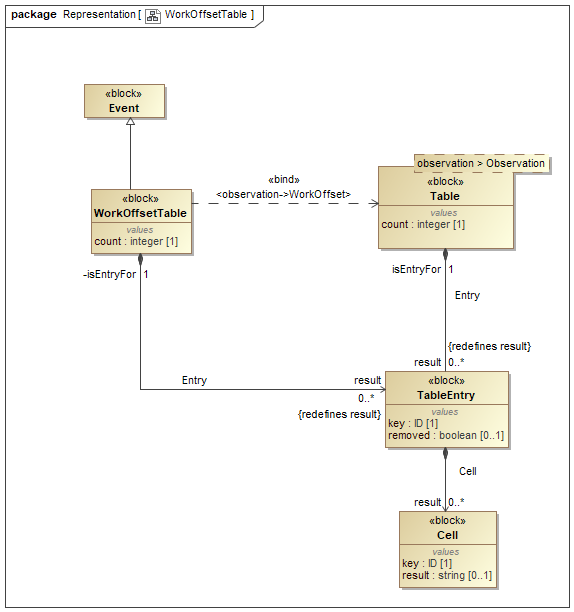
Note: See Representation Schema Diagrams for XML schema.
Tablehas the same behavior as theDataSetfor change tracking, clearing, and history. When anEntrychanges, all Cell entities update at the same time; they are not tracked separately likeEntry.The meaning of each
Entryand Cell MAY be provided as theDataItemEntryDefinition and CellDefinition.keyMUST be the unique identity of theEntrywithin anObservation. key MUST be the unique identity of the Cell within anEntry.Table Example shows
EventObservationtype WorkOffset with a Representation type ofTable.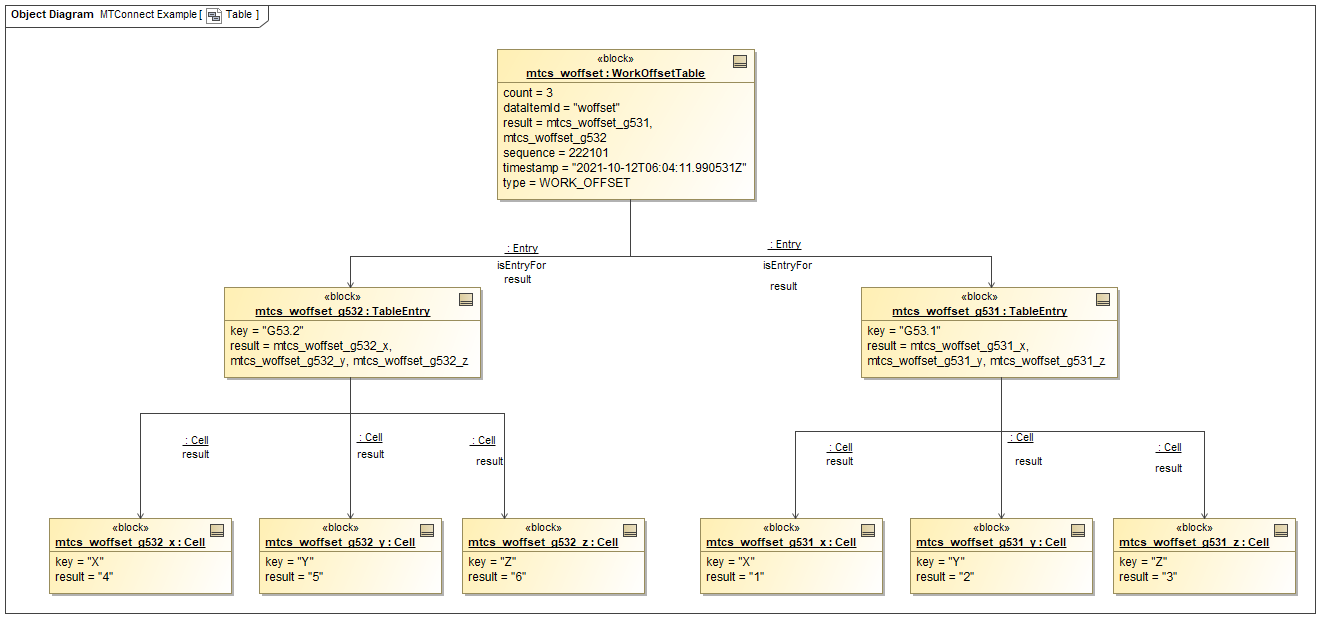
Note: See table-example for the XML representation of the same example.
- TimeSeries
Representation for an
Observationcomposed of a series of sampled data.Description
TimeSeriesfor anObservationis defined by the associatedrepresentationasTIME_SERIES.representationasTIME_SERIESMUST havecategoryofSAMPLE.TemperatureTimeSeries shows the model for
Temperature(Sampletype) with a Representation type ofTimeSeries.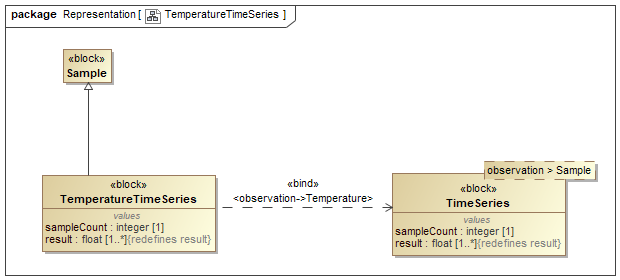
Note: See Representation Schema Diagrams for XML schema.
TimeSeriesMUST report multiple values at fixed intervals in a singleObservation. At minimum, one ofsampleRateorsampleRateMUST be specified. When both are specified, thesampleRatesupersedes thesampleRate.timestampMUST be set to the time the last value was observed. ThedurationMAY indicate the time interval from the first to the last value in the series.Value Properties of TimeSeries defines additional attributes for an
ObservationwithTimeSeriesRepresentation type.- Value
default Representation type for all
Observationtypes whereresulttype is an MTConnect data type. See DataTypes.
Source: MTConnect Institute model documentation, version 2.8.
MTConnect term dictionary · TAMS Model-Aware MTConnect Browser