MTConnect 2.8 package
Representations
This section provides semantic information for the Representation model.
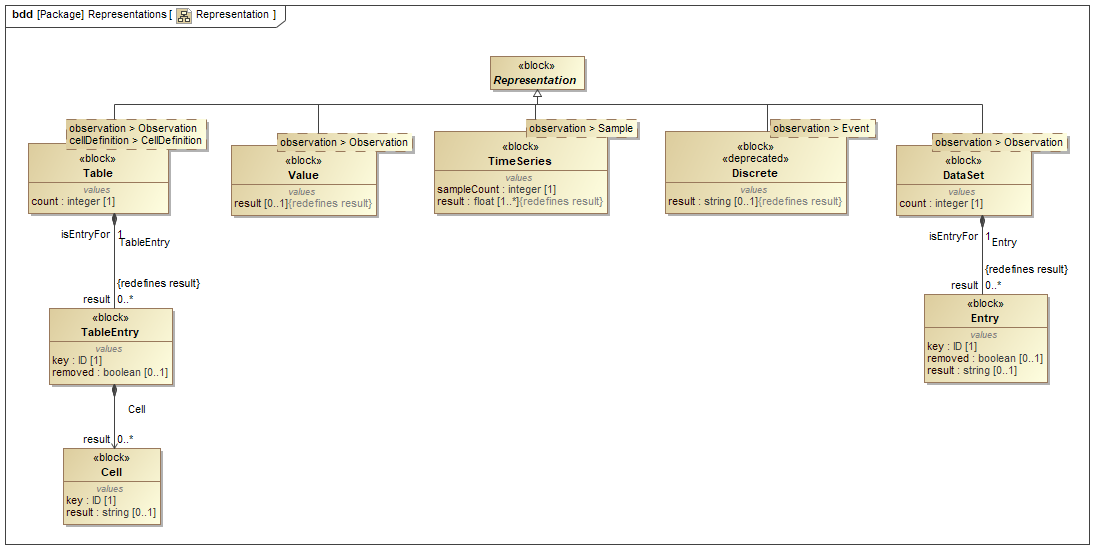
Note: See Representation Schema Diagrams for XML schema.
Classes
- DataSet
Representation for an
Observationcomposed of value(s) represented as a set of key-value pairs.Description
DataSetfor anObservationis defined by the associatedrepresentationasDATA_SET.representationasDATA_SETMUST havecategoryasSAMPLEorEVENT.VariableDataSet shows the model for
Variable(Eventtype) with a Representation type ofDataSet.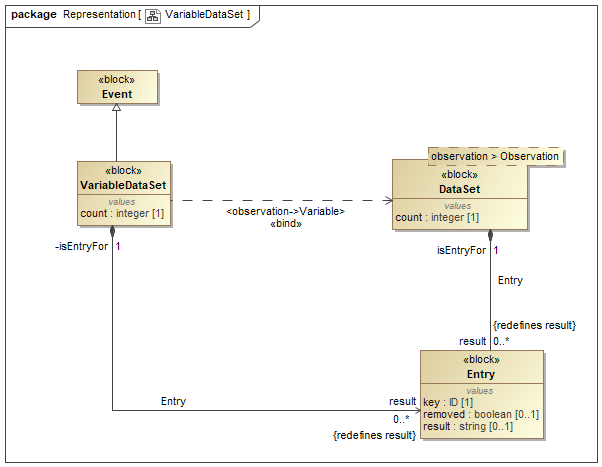
Note: See DataSet Schema for XML schema.
DataSetreports multiple values as a set of key-value pair where each key MUST be unique. The representation of the key-value pair is anEntry. The value of eachEntryMUST have the same constraints and format as theObservationdefined forrepresentationasVALUEfor theDataItemtype. (See Value).The meaning of each
EntryMAY be provided as theDataItemEntryDefinition.DataSet Example shows
EventObservationtypeVariablewith a Representation type ofDataSet.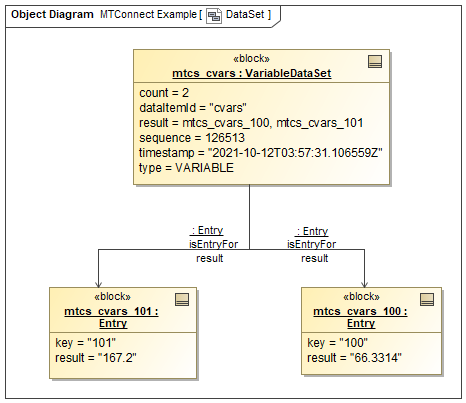
Note: See dataset-example for the XML representation of the same example.
Management of Data Set Observations
An agent MUST maintain the current state of the
DataSetas described in Fundamentals.One or more key-value pairs MAY be added, removed, or changed in an
Observation. An agent MUST publish the changes to one or more key-value pairs as a singleObservation. An agent MUST indicate the removal of a key-value pair from aDataSetusing theremovedastrue.When the
discreteisfalseor is not present, an agent in response to a sample request MUST only publish the changed key-value pair since the previous state of theDataSet.When the
discreteattribute istrue, an agent, in response to a sample request, MUST report all key-value pairs ignoring the state of theDataSet.When an agent responds to a current request, the response document MUST include the full set of key-value pairs. If the current request includes an
atquery parameter, the agent MUST provide the set of key-value pairs at the sequence number.When an
Observationreset occurs, theDataSetMUST remove all key-value pairs making the set empty. TheObservationMAY simultaneously populate theDataSetwith new key-value pairs. The previous entries MUST NOT be included and MUST NOT haveremovedastrue.When the
ObservationisUNAVAILABLEtheDataSetMUST remove all key-value pairs making the set empty.- Discrete
DEPRECATED Representation for an
Observationwhere each discrete occurrence of the data may have the same value as the previous occurrence of the data.Description
Discrete for an
Observationis defined by the associatedrepresentationasDISCRETE.representationasDISCRETEMUST havecategoryasEVENT.MTConnect Version 1.5 replaced
representationasDISCRETEwithdiscrete.Each occurrence of the
ObservationMAY have the same value as the previous occurrence, and MUST NOT suppress duplicates.Examples of Discrete: A
PartCountreporting the completion of each part using a 1 to indicate completion of a single part, aMessagethat occurs each time a door opens.- Entry
key-value pair published as part of a
DataSet.Constraints for Entry Values
The value of each
EntryMUST have the same restrictions as the value of an observation withrepresentationasVALUE.An
EntryMAY be further constrained by theDataItemdefinition (see Device Information Model), for example aVariableDataSethaving a string value MAY have a floating-pointTemperaturevalue. A restriction MUST NOT be broadened or removed, for example, the value "READY" MUST NOT occur with aTemperatureDataSetconstrained to floating-point numbers.EntryDefinition MAY provide the type and units of an
key.- Representation
specifies the format and structure of
result.Description
The Representation type for an
Observationis defined by the associatedrepresentationin the MTConnectDevices Response Document.Value is the default Representation type for all
Observationtypes.The name of the
Observationtype is modified for all Representation types other than Value by appending the pascal case of the Representation type.Example: The name for
SampleObservationtypeTemperaturewithRepresentationtype ofTimeSeriesbecomesTemperatureTimeSeries.- TimeSeries
Representation for an
Observationcomposed of a series of sampled data.Description
TimeSeriesfor anObservationis defined by the associatedrepresentationasTIME_SERIES.representationasTIME_SERIESMUST havecategoryofSAMPLE.TemperatureTimeSeries shows the model for
Temperature(Sampletype) with a Representation type ofTimeSeries.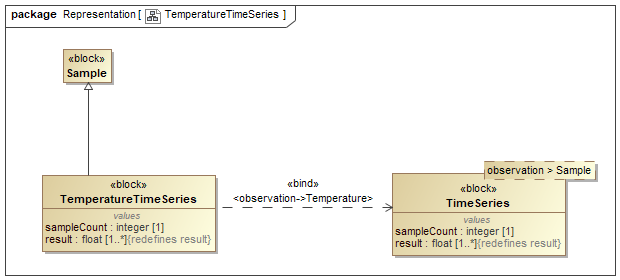
Note: See Representation Schema Diagrams for XML schema.
TimeSeriesMUST report multiple values at fixed intervals in a singleObservation. At minimum, one ofsampleRateorsampleRateMUST be specified. When both are specified, thesampleRatesupersedes thesampleRate.timestampMUST be set to the time the last value was observed. ThedurationMAY indicate the time interval from the first to the last value in the series.Value Properties of TimeSeries defines additional attributes for an
ObservationwithTimeSeriesRepresentation type.- Value
default Representation type for all
Observationtypes whereresulttype is an MTConnect data type. See DataTypes.
Packages
- Table
This section provides semantic information for the Representation type
Table.
Source: MTConnect Institute model documentation, version 2.8.
MTConnect term dictionary · TAMS Model-Aware MTConnect Browser