MTConnect 2.8 class
Component
logical or physical entity that provides a capability.
Description
Component is an abstract entity and will be realized by specific Component types for an MTConnectDevices entity. See Component Types for more details on the Component types.
Component also provides structure for describing the lower level entities associated with it.
At least one of Component, DataItem, or Reference entities MUST be provided for a Component.
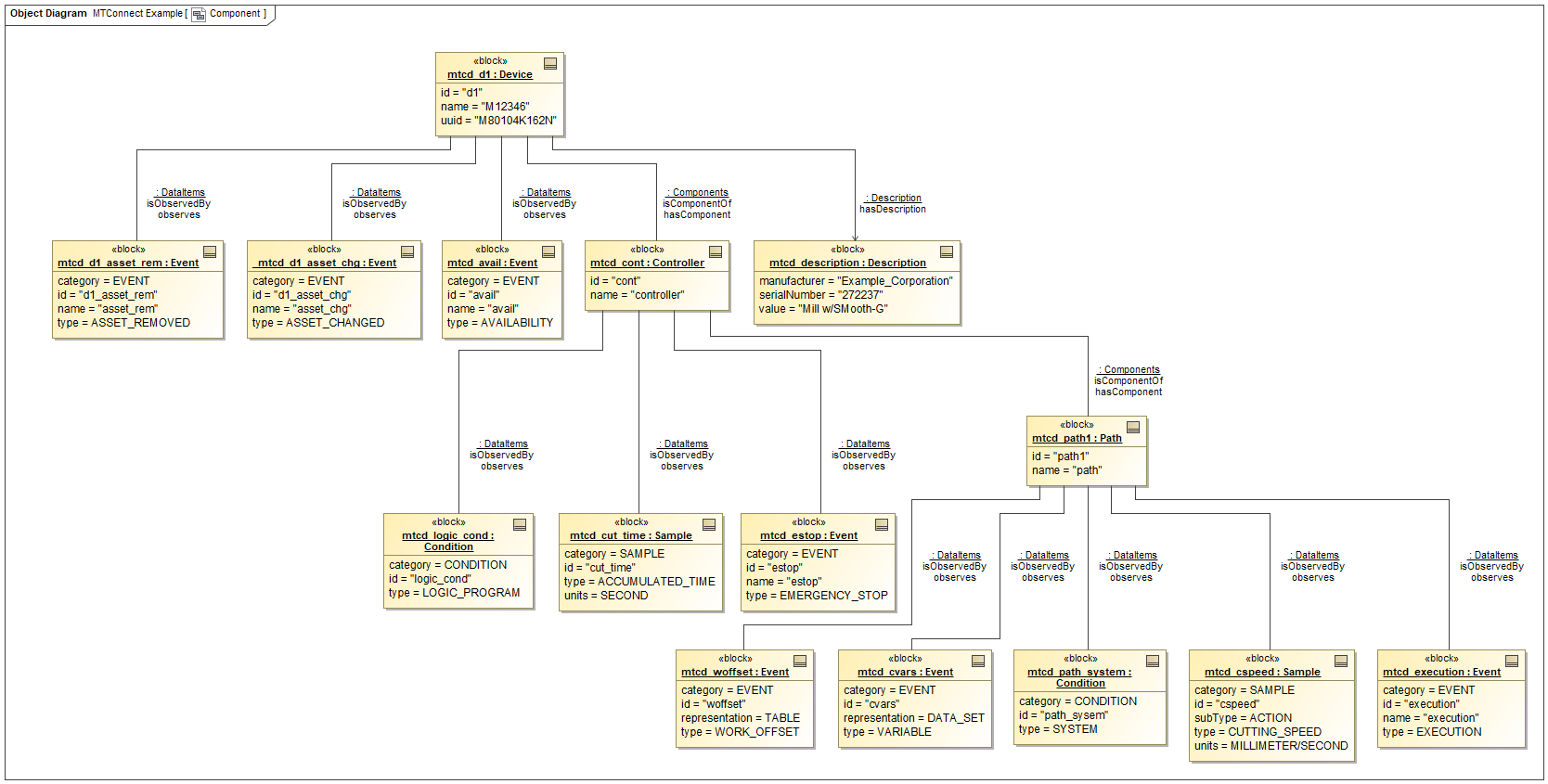
Note: See component-example for the XML representation of the same example.
Introduced in MTConnect 1.0.
Abstract class.
Inheritance
Base classes, from the immediate parent to the root:
Subclasses
- Adapter
Componentthat provides information about the data source for an MTConnect Agent.Description
It MAY contain connectivity state of the data source and additional telemetry about the data source and source-specific information.
- Adapters
Componentthat organizesAdaptertypes.- Amplifier
leaf
Componentcomposed of an electronic component or circuit that amplifies power, electric current, or voltage.- Auxiliaries
- Auxiliary
abstract
Componentcomposed of removable part(s) of a piece of equipment that provides supplementary or extended functionality.- Axes
Componentthat organizesAxistypes.- Axis
abstract
Componentcomposed of a motion system that provides linear or rotational motion for a piece of equipment.Description
In robotics, the term Axis is synonymous with Joint. A Joint is the connection between two parts of the structure that move in relation to each other.
Linear and Rotary components MUST have
namethat MUST follow the conventions described below. Use thenativeNamefor the manufacturer's name of the axis if it differs from the assignedname.MTConnect has two high-level classes for automation equipment as follows: (1) Equipment that controls cartesian coordinate axes and (2) Equipment that controls articulated axes. There are ambiguous cases where some machines exhibit both characteristics; when this occurs, the primary control system's configuration determines the classification.
Examples of cartesian coordinate equipment are CNC Machine Tools, Coordinate measurement machines, as specified in ISO 841, and 3D Printers. Examples of articulated automation equipment are Robotic systems as specified in ISO 8373.
The following sections define the designation of names for the axes and additional guidance when selecting the correct scheme to use for a given piece of equipment.
Cartesian Coordinate Naming Conventions
A Three-Dimensional Cartesian Coordinate control system organizes its axes orthogonally relative to a machine coordinate system where the manufacturer of the equipment specifies the origin.
Axes
nameSHOULD comply with ISO 841, if possible.Linear Motion
A piece of equipment MUST represent prismatic motion using a Linear axis and assign its
nameusing the designationsX,Y, andZ. A Linear axisnameMUST append a monotonically increasing suffix when there are more than one parallel axes; for example,X2,X3, andX4.Rotary Motion
MTConnect MUST assign the
nameto Rotary axes exhibiting rotary motion usingA,B, andC. A Rotary axisnameMUST append a monotonically increasing suffix when more than one Rotary axis rotates around the same Linear axis; for example,A2,A3, andA4.Articulated Machine Control Systems
An articulated control system's axes represent the connecting linkages between two adjacent rigid members of an assembly. The Linear axis represents prismatic motion, and the Rotary axis represents the rotational motion of the two related members. The control organizes the axes in a kinematic chain from the mounting surface (base) to the end-effector or tooling.
Articulated Machine Axis Names
The axes of articulated machines represent forward kinematic relationships between mechanical linkages. Each axis is a connection between linkages, also referred to as joints, and MUST be named using a
Jfollowed by a monotonically increasing number; for example,J1,J2,J3. The numbering starts at the base axis connected or closest to the mounting surface,J1, incrementing to the mechanical interface,Jn, wherenis the number of the last axis. The chain forms a parent-child relationship with the parent being the axis closest to the base.A machine having an axis with more than one child MUST number each branch using its numeric designation followed by a branch number and a monotonically increasing number. For example, if
J2has two children, the first child branch MUST be namedJ2.1.1and the second child branchJ2.2.1. A child of the first branch MUST be namedJ2.1.2, incrementing toJ2.1.n, whereJ2.1.nis the number of the last axis in that branch.- Ballscrew
leaf
Componentcomposed of a mechanical structure that transforms rotary motion into linear motion.- Belt
leaf
Componentcomposed of an endless flexible band that transmits motion for a piece of equipment or conveys materials and objects.- Brake
leaf
Componentthat slows or stops a moving object by the absorption or transfer of the energy of momentum, usually by means of friction, electrical force, or magnetic force.- Chain
leaf
Componentcomposed of interconnected series of objects that band together and are used to transmit motion for a piece of equipment or to convey materials and objects.- Chopper
leaf
Componentthat breaks material into smaller pieces.- Chuck
leaf
Componentcomposed of a mechanism that holds a part or stock material in place.- Chute
leaf
Componentcomposed of an inclined channel that conveys material.- CircuitBreaker
leaf
Componentthat interrupts an electric circuit.- Clamp
leaf
Componentthat strengthens, support, or fastens objects in place.- Compressor
leaf
Componentcomposed of a pump or other mechanism that reduces volume and increases pressure of gases in order to condense the gases to drive pneumatically powered pieces of equipment.- CoolingTower
leaf
Componentcomposed of a heat exchange system that uses a fluid to transfer heat to the atmosphere.- Device
Componentcomposed of a piece of equipment that produces observations about itself.Description
A
Deviceorganizes its parts asComponententities.A
DeviceMUST have anameanduuidto identify itself.A
DeviceMUST have the followingDataItems: Availability, AssetChanged, and AssetRemoved.See Components for more details on the properties of
Device.See Part Properties of Device for a list of top level
Componenttypes for aDevice.- Door
Componentcomposed of a mechanical mechanism or closure that can cover a physical access portal into a piece of equipment allowing or restricting access to other parts of the equipment.Description
The closure can be opened or closed to allow or restrict access to other parts of the equipment.
Door MUST have DoorState data item to indicate if the door is
OPEN,CLOSED, orUNLATCHED. AComponentMAY contain multiple Door entities.- Drain
leaf
Componentthat allows material to flow for the purpose of drainage from, for example, a vessel or tank.- Encoder
leaf
Componentthat measures position.- Environmental
Componentthat observes the surroundings of anotherComponent.Note: Environmental SHOULD be organized by
Auxillaries, Systems or Parts depending on the relationship to theComponent.- ExpiredPot
leaf
Componentthat is a Pot for a tool that is no longer usable for removal from a ToolMagazine or Turret.- ExposureUnit
leaf
Componentthat emits a type of radiation.- ExtrusionUnit
leaf
Componentthat dispenses liquid or powered materials.- Fan
leaf
Componentthat produces a current of air.- Filter
leaf
Componentthrough which liquids or gases are passed to remove suspended impurities or to recover solids.- Galvanomotor
leaf
Componentcomposed of an electromechanical actuator that produces deflection of a beam of light or energy in response to electric current through its coil in a magnetic field.- Gripper
leaf
Componentthat holds a part, stock material, or any other item in place.- Hopper
leaf
Componentcomposed of a chamber or bin in which materials are stored temporarily, typically being filled through the top and dispensed through the bottom.- Interface
abstract
Componentthat coordinates actions and activities between pieces of equipment.- Interfaces
Componentthat organizesInterfacetypes.- LinearPositionFeedback
leaf
Componentthat measures linear motion or position.DEPRECATION WARNING : May be deprecated in the future. Recommend using Encoder.
- Lock
Componentthat physically prohibits aDeviceorComponentfrom opening or operating.- Motor
leaf
Componentthat converts electrical, pneumatic, or hydraulic energy into mechanical energy.- Oil
leaf
Componentcomposed of a viscous liquid.- Part
abstract
Componentcomposed of a part being processed by a piece of equipment.- Parts
Componentthat organizesParttypes.- Path
Componentthat organizes an independent operation or function within a Controller.Description
For many types of equipment, Path organizes a set of Axes, one or more Program elements, and the data associated with the motion of a control point as it moves through space. However, it MAY also represent any independent function within a Controller that has unique data associated with that function.
Path SHOULD provide an Execution data item to define the operational state of the Controller of the piece of equipment.
If the Controller is capable of performing more than one independent operation or function simultaneously, a separate Path MUST be used to organize the data associated with each independent operation or function.
- Pot
leaf
Componentcomposed of a tool storage location associated with a ToolMagazine or AutomaticToolChanger.- Power
Power was DEPRECATED in MTConnect Version 1.1 and was replaced by Availability data item type.
- PowerSupply
leaf
Componentthat provides power to electric mechanisms.- Process
abstract
Componentcomposed of a manufacturing process being executed on a piece of equipment.- Processes
Componentthat organizesProcesstypes.- Pulley
leaf
Componentcomposed of a mechanism or wheel that turns in a frame or block and serves to change the direction of or to transmit force.- Pump
leaf
Componentthat raises, drives, exhausts, or compresses fluids or gases by means of a piston, plunger, or set of rotating vanes.- Reel
leaf
Componentcomposed of a rotary storage unit for material.- RemovalPot
leaf
Componentthat is a Pot for a tool that has to be removed from a ToolMagazine or Turret to a location outside of the piece of equipment.- Resource
abstract
Componentcomposed of material or personnel involved in a manufacturing process.- Resources
Componentthat organizesResourcetypes.- ReturnPot
leaf
Componentthat is a Pot for a tool that has been removed from spindle or Turret and awaiting for return to a ToolMagazine.- SensingElement
leaf
Componentthat provides a signal or measured value.- Sensor
Componentthat responds to a physical stimulus and transmits a resulting impulse or value from a sensing unit.Description
If modeling individual sensors, then sensor should be associated with the
Componentthat the measured value is most closely associated.When modeled as an Auxiliary, sensor SHOULD represent an integrated sensor unit system that provides signal processing, conversion, and communications. A sensor unit may have multiple sensing elements.
See SensorConfiguration for more details on the use and configuration of a
Sensor.- Spreader
leaf
Componentthat flattens or spreading materials.- StagingPot
leaf
Componentthat is a Pot for a tool that is awaiting transfer to a ToolMagazine or Turret from outside of the piece of equipment.- Station
leaf
Componentcomposed of a storage or mounting location for a tool associated with a Turret, GangToolBar, or ToolRack.- StorageBattery
leaf
Componentcomposed of one or more cells in which chemical energy is converted into electricity and used as a source of power.- Structure
Componentcomposed of part(s) comprising the rigid bodies of the piece of equipment.- Structures
- Switch
leaf
Componentthat turns on or off an electric current or makes or breaks a circuit.- System
abstract
Componentthat is permanently integrated into the piece of equipment.- Systems
Componentthat organizesSystemtypes.- Table
leaf
Componentcomposed of a surface for holding an object or material.- Tank
leaf
Componentgenerally composed of an enclosed container.- Tensioner
leaf
Componentthat provides or applies a stretch or strain to another mechanism.- TransferArm
leaf
Componentthat physically moves a tool from one location to another.- TransferPot
leaf
Componentthat is a Pot for a tool that is awaiting transfer from a ToolMagazine to spindle or Turret.- Transformer
leaf
Componentthat transforms electric energy from a source to a secondary circuit.- Valve
leaf
Componentthat halts or controls the flow of a liquid, gas, or other material through a passage, pipe, inlet, or outlet.- Vat
leaf
Componentgenerally composed of an open container.- Water
leaf
Componentcomposed of $$H_2 O$$.- Wire
leaf
Componentcomposed of a string like piece or filament of relatively rigid or flexible material provided in a variety of diameters.- Workpiece
leaf
Componentcomposed of an object or material on which a form of work is performed.
Properties
Includes inherited members. Defined by identifies the class that declares each member.
| Name | Type | Multiplicity | Introduced | Deprecated | Defined by | Definition |
|---|---|---|---|---|---|---|
| coordinateSystemIdRef | string | 0..1 | 1.8 | Component | specifies the CoordinateSystem for this Access: public | |
| id | string | 1 | 1.0 | Component | unique identifier for the Access: public | |
| name | string | 0..1 | 1.0 | Component | name of the When provided, Access: public | |
| nativeName | string | 0..1 | 1.1 | Component | common name associated with Access: public | |
| sampleInterval | float | 0..1 | 1.2 | Component | interval in milliseconds between the completion of the reading of the data associated with the This information may be used by client software applications to understand how often information from a The refresh rate for data from all child Access: public | |
| sampleRate | float | 0..1 | 1.0 | 1.2 | Component | DEPRECATED in MTConnect Version 1.2. Replaced by Access: public |
| uuid | string | 0..1 | 1.0 | Component | universally unique identifier for the Access: public | |
| belongs to | Component | 1 | Component (inherited) | the owner of a component. a device may not belong to any other component. Access: public | ||
| has component | Component | 0..* | Component (inherited) | a component relationship that inheres other components. Access: public | ||
| has composition | Composition | 0..* | Component (inherited) | Access: private | ||
| has configuration | Configuration | 0..* | Component (inherited) | Access: private | ||
| observes | DataItem | 0..* | Component (inherited) | Access: private |
Parts
Includes inherited members. Defined by identifies the class that declares each member.
| Name | Type | Multiplicity | Introduced | Deprecated | Defined by | Definition |
|---|---|---|---|---|---|---|
| hasComponent | Component | 0..* | Component | Association: Components Access: public Aggregation: composite | ||
| hasComposition | Composition | 0..* | Component | Association: Compositions Access: public Aggregation: composite | ||
| hasConfiguration | Configuration | 0..1 | Component | Association: Configuration Access: public Aggregation: composite | ||
| hasDescription | Description | 0..1 | Component | Association: Description Access: public Aggregation: composite | ||
| hasReference | Reference | 0..* | Component | Association: References Access: public Aggregation: composite | ||
| madeObservation | Observation | 0..* | Component | Association: Observations Access: public Aggregation: composite | ||
| observes | DataItem | 0..* | Component | Association: DataItems Access: public Aggregation: composite |
Relationships
Includes inherited members. Defined by identifies the class that declares each member.
| Name | Type | Multiplicity | Introduced | Deprecated | Defined by | Definition |
|---|---|---|---|---|---|---|
| hasComponentStream | ComponentStream | 0..1 | Component | Association: ComponentStream Access: public Aggregation: shared | ||
| isComponentOf | Component | 0..1 | Component | Association: Components Access: private |
Part of
- Amplifier::hasComponent (0..*)
- Ballscrew::hasComponent (0..*)
- Belt::hasComponent (0..*)
- Brake::hasComponent (0..*)
- Chain::hasComponent (0..*)
- Chopper::hasComponent (0..*)
- Chute::hasComponent (0..*)
- CircuitBreaker::hasComponent (0..*)
- Clamp::hasComponent (0..*)
- Component::hasComponent (0..*)
- Compressor::hasComponent (0..*)
- CoolingTower::hasComponent (0..*)
- Drain::hasComponent (0..*)
- Encoder::hasComponent (0..*)
- ExpiredPot::hasComponent (0..*)
- ExposureUnit::hasComponent (0..*)
- ExtrusionUnit::hasComponent (0..*)
- Fan::hasComponent (0..*)
- Filter::hasComponent (0..*)
- Galvanomotor::hasComponent (0..*)
- Gripper::hasComponent (0..*)
- Hopper::hasComponent (0..*)
- LinearPositionFeedback::hasComponent (0..*)
- Motor::hasComponent (0..*)
- Oil::hasComponent (0..*)
- Pot::hasComponent (0..*)
- PowerSupply::hasComponent (0..*)
- Pulley::hasComponent (0..*)
- Pump::hasComponent (0..*)
- Reel::hasComponent (0..*)
- RemovalPot::hasComponent (0..*)
- ReturnPot::hasComponent (0..*)
- SensingElement::hasComponent (0..*)
- Spreader::hasComponent (0..*)
- StagingPot::hasComponent (0..*)
- Station::hasComponent (0..*)
- StorageBattery::hasComponent (0..*)
- Switch::hasComponent (0..*)
- Table::hasComponent (0..*)
- Tank::hasComponent (0..*)
- Tensioner::hasComponent (0..*)
- TransferArm::hasComponent (0..*)
- TransferPot::hasComponent (0..*)
- Transformer::hasComponent (0..*)
- Valve::hasComponent (0..*)
- Vat::hasComponent (0..*)
- Water::hasComponent (0..*)
- Wire::hasComponent (0..*)
- Workpiece::hasComponent (0..*)
Constraints
val:MustHaveComponentOrDataItemOrReference a sh:NodeShape ; sh:message "
ComponentMUST have at least one ofComponent,DataItemorReferenceentities." ; sh:targetClass mt:Component ; sh:or ( [ sh:property [ sh:path mt:hasComponent ; sh:minCount 1 ; sh:class mt:Component ; ] ] [ sh:property [ sh:path mt:observes ; sh:minCount 1 ; sh:class mt:DataItem ; ] ] [ sh:property [ sh:path mt:hasReference ; sh:minCount 1 ; sh:class mt:Reference ; ] ] ) .
Source: MTConnect Institute model documentation, version 2.8.
MTConnect term dictionary · TAMS Model-Aware MTConnect Browser