MTConnect 2.8 package
Components
This section provides semantic information for the Component entity. Components shows the Component model.
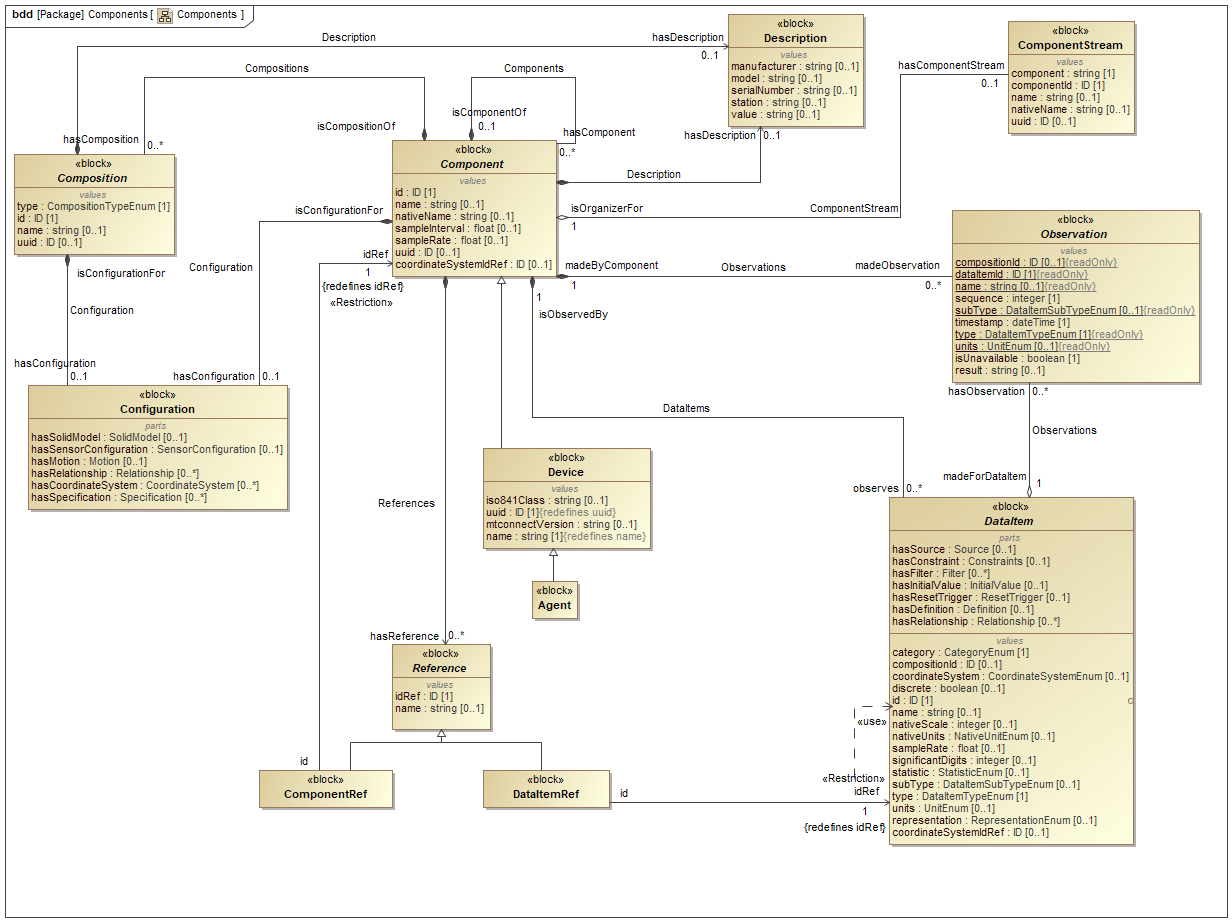
Note: See Components Schema Diagrams for XML schema.
Components Model
MTConnectDevices provides the physical and logical architecture of a piece of equipment. Device Entity Hierarchy Example provides an overview of the entities used in an example of an MTConnectDevices entity.
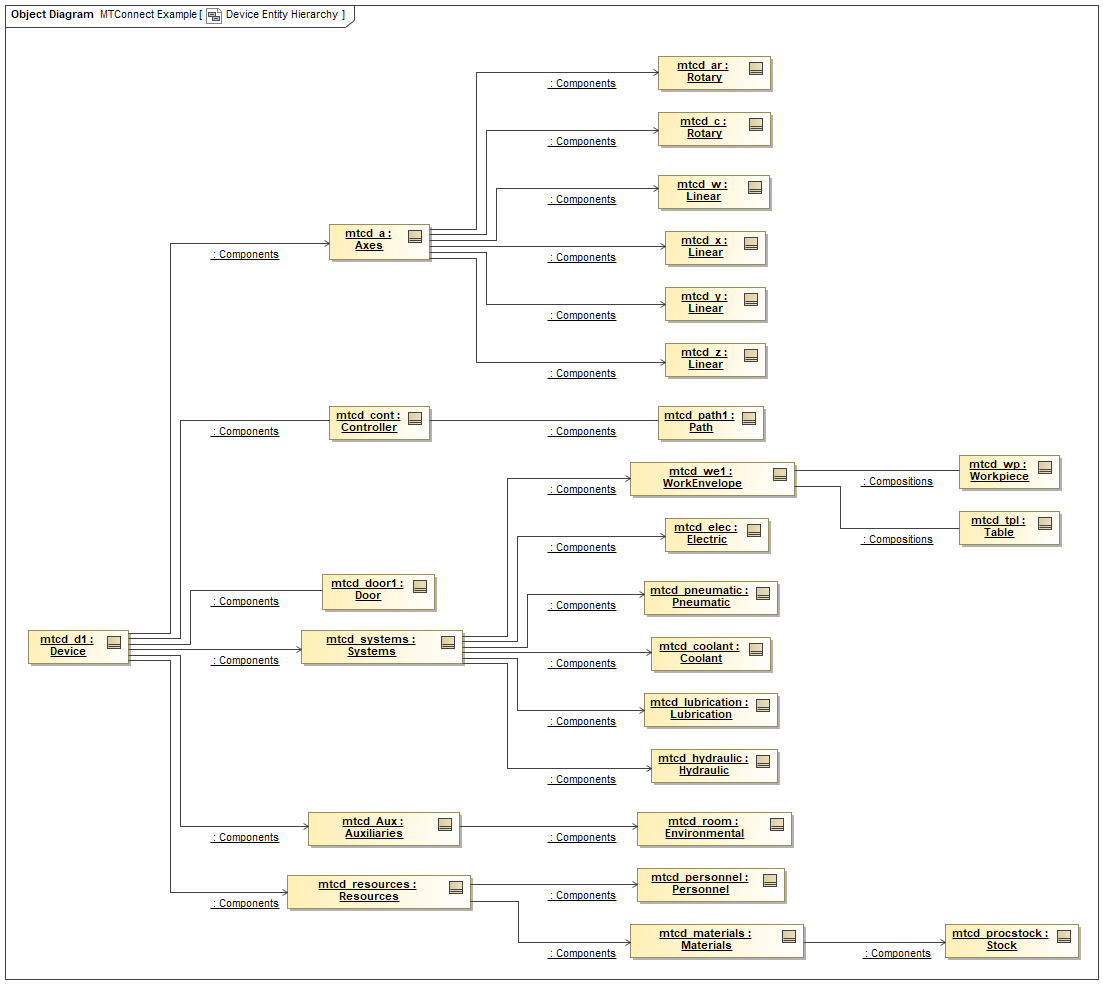
Note 1 to entry: See device-entity-hierarchy-example for the XML representation of the same example.
Note 2 to entry: Example above only shows the
ComponentandCompositionlevel hierarchy. For a complete semantics on each kind see Components and Compositions.
A variety of entities are defined to describe a piece of equipment. Some of these entities MUST always be defined for an MTConnectDevices entity, while others are optional and MAY be used, as required, to provide additional structure.
The first, or highest level, entity defined for an MTConnectDevices entity is Devices. Devices is used to group one or more pieces of equipment into a single document. Devices MUST always be defined for an MTConnectDevices entity.
Device is the next entity defined for the MTConnectDevices entity. A separate Device entity is used to identify each piece of equipment for an MTConnectDevices entity. Each Device provides information on the physical and logical structure of the piece of equipment and the data associated with that equipment. Device can also represent any logical grouping of pieces of equipment that function as a unit or any other data source that provides data through an agent.
One or more Device entities MUST always be defined for an MTConnectDevices entity.
Components is the next entity defined for the MTConnectDevices entity. Components is used to group information describing lower level physical parts or logical functions of a piece of equipment.
Component is the next level of entity defined for the MTConnectDevices entity. Component is both an abstract type entity and an organizer type entity.
As an abstract entity, Component will always be realized by a specific Component type defined in Component Types. Each Component can also be used to organize information describing lower level entities or DataItems associated with the Component.
If lower level entities are described, these entities are by definition child Component entities of a parent Component. At this next level, the lower level child Component entities are grouped by Components.
A Component MAY be further decomposed into Composition entities that are grouped by Compositions. These describe the lowest level basic structural or functional building blocks contained within a Component. Data provided for a Component provides more specific meaning when it is associated with one of the Composition entities of the Component. The different Composition types that MAY be defined for the MTConnectDevices entity are defined in Compositions.
This parent-child relationship can continue to any depth required to fully define a piece of equipment.
Note: See Device Entity Hierarchy Example for an example.
Classes
- Component
logical or physical entity that provides a capability.
Description
Componentis an abstract entity and will be realized by specificComponenttypes for an MTConnectDevices entity. See Component Types for more details on theComponenttypes.Componentalso provides structure for describing the lower level entities associated with it.At least one of
Component,DataItem, orReferenceentities MUST be provided for aComponent.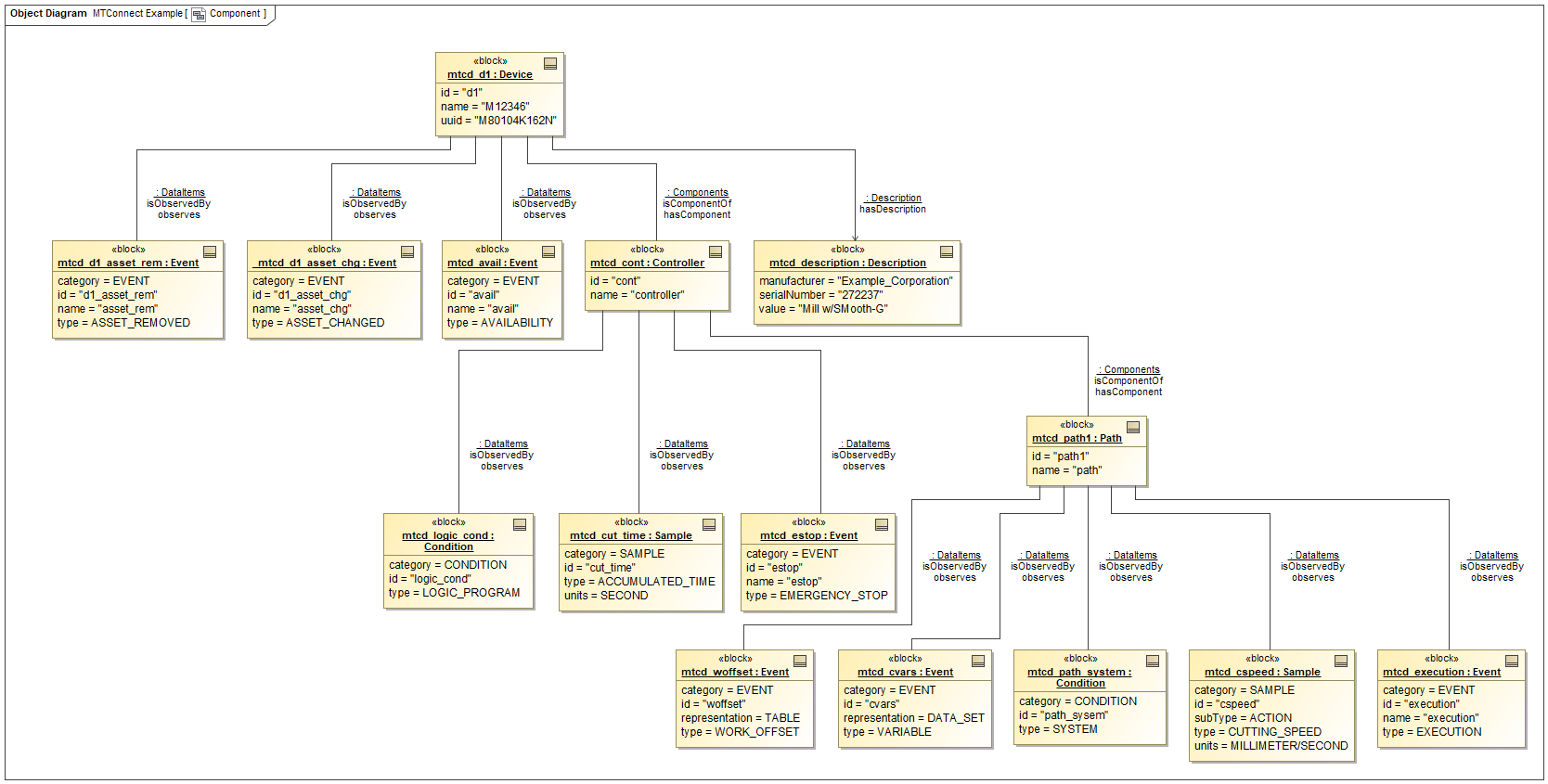
Note: See component-example for the XML representation of the same example.
- Description
descriptive content.
Description
Note 1 to entry: See Component Example for an example.
Note 2 to entry: See component-example for the XML representation of the same example.
Packages
- Component Types
This section provides semantic information for the types of
Component.Note: In the XML representation,
Componententities are defined into two major categories:- top level
Componententities that organizes the most significant physical or logical functions of a piece of equipment (see Part Properties of Device). They MAY also be used as lower levelComponententities; as required. See Component Organizer Types.
- lower level
Componententities composed of the sub-parts of the parentComponentto provide more clarity and granularity to the physical or logical structure of the top levelComponententities.
This section provides guidance for the most common relationships between
Componenttypes. However, allComponenttypes MAY be used in any configuration, as required, to fully describe a piece of equipment.As described in Components,
Componentis an abstract entity and will be always realized by a specificComponenttype.- top level
- Devices
This section provides semantic information for the
Devicetypes.
Source: MTConnect Institute model documentation, version 2.8.
MTConnect term dictionary · TAMS Model-Aware MTConnect Browser